



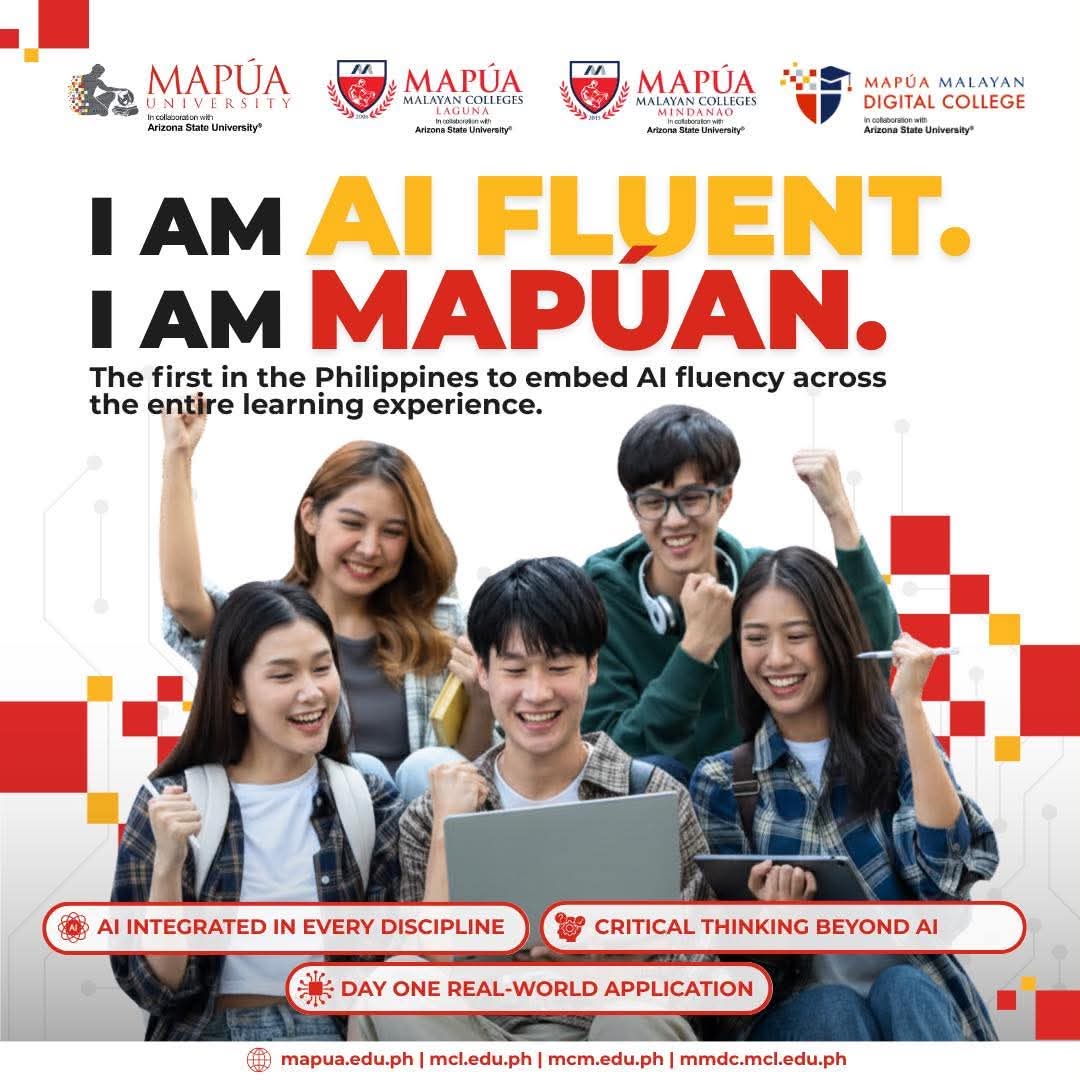
The Mapúa Education Group (Mapúa)—comprising Mapúa University, Mapúa Malayan Colleges Laguna (MMCL), Mapúa Malayan Colleges Mindanao (MMCM), and Mapúa Malayan Digital College (MMDC)—in collaboration with Arizona State University (ASU), is once again redefining the country’s academic landscape by launching the Philippines’ very first comprehensive institutional AI Fluency Strategy. Moving past basic AI literacy, this game changing initiative completely redesigns the university’s academic model to develop discipline-grounded, human-centered, and future-ready graduates capable of mastering human-AI collaboration to solve complex real-world problems.
“It is important for Mapúa to be at the forefront because the group has a long tradition of preparing professionals for fields that build the country—engineering, architecture, technology, business, sciences, and other disciplines. As AI transforms these fields, Mapúa has a responsibility to help define what future-ready education should look like in the Philippines. Advocating AI fluency also supports Mapúa’s broader mission of student success, innovation, digital transformation, lifelong learning, and nation-building. If Philippine higher education is to remain relevant, it must prepare graduates who can work with AI responsibly and productively, not only graduates who are aware of AI at a basic level,” Mapúa President and CEO Dodjie S. Maestrecampo remarked.
A Crucial Shift from AI Literacy to AI Fluency
While many institutions focus merely on introductory AI usage, the whole of Mapúa establishes a definitive line between basic tool awareness and true, professional fluency.
“AI literacy is the ability to understand what AI is, how it works, what its limitations are, and how to use it responsibly. It is the necessary starting point. Students learn about generative AI, prompting, hallucinations, bias, data privacy, academic integrity, and responsible use. AI fluency goes beyond awareness and basic use. It means that students can apply AI meaningfully within their discipline, evaluate AI outputs critically, improve AI-assisted work using human judgment, and remain accountable for the final output,” Maestrecampo explained.
“At Mapúa, this difference becomes evident in the learning experience because AI is not only treated as a tool or a topic in one course. It is embedded across the curriculum through four layers: AI for all, AI in the discipline, AI for learning, and advanced AI pathways. In practical terms, an AI-literate student may know how to use an AI tool but an AI-fluent Mapúan knows when to use AI, how to question its output, how to apply disciplinary standards, how to detect errors or bias, and how to use AI to solve real problems responsibly,” he added.
Without this deliberate transition to fluency, traditional academic institutions risk falling behind rapidly evolving workforce standards and the ever-dynamic global landscape.
“The transition is vital because AI is already changing the way knowledge is produced, work is performed, and professional decisions are made. For Mapúa, moving to AI fluency is a way of keeping the institution relevant to the needs of the new century. The student learning behaviors as well as industry expectations and the professions for which we prepare our students are evolving. If the university remains only at the level of AI literacy, we risk preparing students with capabilities suited for a world that is rapidly becoming outdated,” the Mapúa executive noted.
The AI Fluency Blueprint
Rolling out fully for Academic Year (AY) 2026-2027, Mapúa’s AI Fluency action plan introduces comprehensive upgrades across the entire student lifecycle. The agile four-layer curriculum seamlessly integrates artificial intelligence across all programs, moving from foundational generative AI concepts up to advanced pathways like AI Engineering and Data Science. Under the innovative and pioneering ‘HyFlip’ pedagogical model, Mapúa inverts traditional classroom learning by shifting basic content transmission to AI-supported asynchronous study, saving vital face-to-face class hours for critical debate, mentoring, and collaborative problem-solving.
Furthermore, the university is tackling academic integrity head-on through a process-based assessment framework that explicitly classifies coursework into AI-prohibited, AI-assisted, or AI-integrated tasks, shifting the evaluation focus toward the student’s iterative critical thinking process rather than just the final output. To support this massive transition, the newly developed Mapúa AI Teaching Commons serves as a continuous faculty development hub to build instructional capacity and transform educators into cognitive coaches. These learning tracks are supported by stackable, industry-recognized AI fluency microcredentials built into degree tracks and accessible to professional alumni upskilling for modern automated workplaces.
“Ushering in the era of AI requires Mapúa to redesign not only what we teach, but how we teach, how we assess, how we can support students, how we conduct research, and how we operate as an educational institution. It is imperative to make AI fluency a common competency of Mapúa graduates,” Maestrecampo highlighted.
Empowering Mapúans to Lead with a Global Edge
By treating human judgment coupled with tech skills as the premium competitive edge in an increasingly automating global landscape, Mapúa ensures its graduates step directly into high-impact, relevant careers.
“For students, AI fluency strengthens their ability to analyze information, evaluate outputs, detect errors, ask better questions, and produce higher-quality work. It also helps them understand how AI is transforming their specific fields. For graduates, AI fluency becomes an employability advantage. It gives them the ability to enter the workplace ready to collaborate with intelligent systems, adapt to changing technologies, and contribute to innovation. More importantly, it helps them remain critical and accountable for the human side of work—ethics, accuracy, fairness, context, and impact,” Dr. Maestrecampo further explained.
As the country’s premier technological institution enters its next century of academic leadership, the focus remains firm on driving meaningful, nation-building innovation.
“We are in the next stage of Mapúa’s continuing mission—to prepare learners who can lead in a changing world, contribute to industry and society, and advance nation-building. Mapúa must not only adapt to the age of AI, Mapúa must help shape it,” Maestrecampo declared.
Earlier this year, the Mapúa Education Group marked another pioneering initiative in the history of Philippine education—the introduction of ChatGPT Edu. Through this group-wide collaboration with OpenAI, its community of students, faculty, and employees gain access to specialized and advanced AI features designed for high-level academic and professional rigor.
Mapúa consists of flagship schools under iPeople, Inc. — the education joint venture between majority owner House of Investments (the listed holding company of the Yuchengco Group of Companies) and Ayala Corporation. The Mapúa Education Group operates a comprehensive, system-wide collaboration with Arizona State University (ASU), the top-ranked U.S. and global educational institution for innovation and research, making world-class, tech-forward education accessible to Filipino students.