

Scientific breakthroughs and innovations often make headlines, but behind every discovery are researchers whose curiosity, persistence, and dedication drive the pursuit of new knowledge. At Mapúa University, three faculty members have been recognized for their research contributions after being included in the Stanford–Elsevier World’s Top 2% Scientists ranking: Dr. Ardvin Kester Ong, Dr. Reggie Pantig, and Mr. Louie Giray.
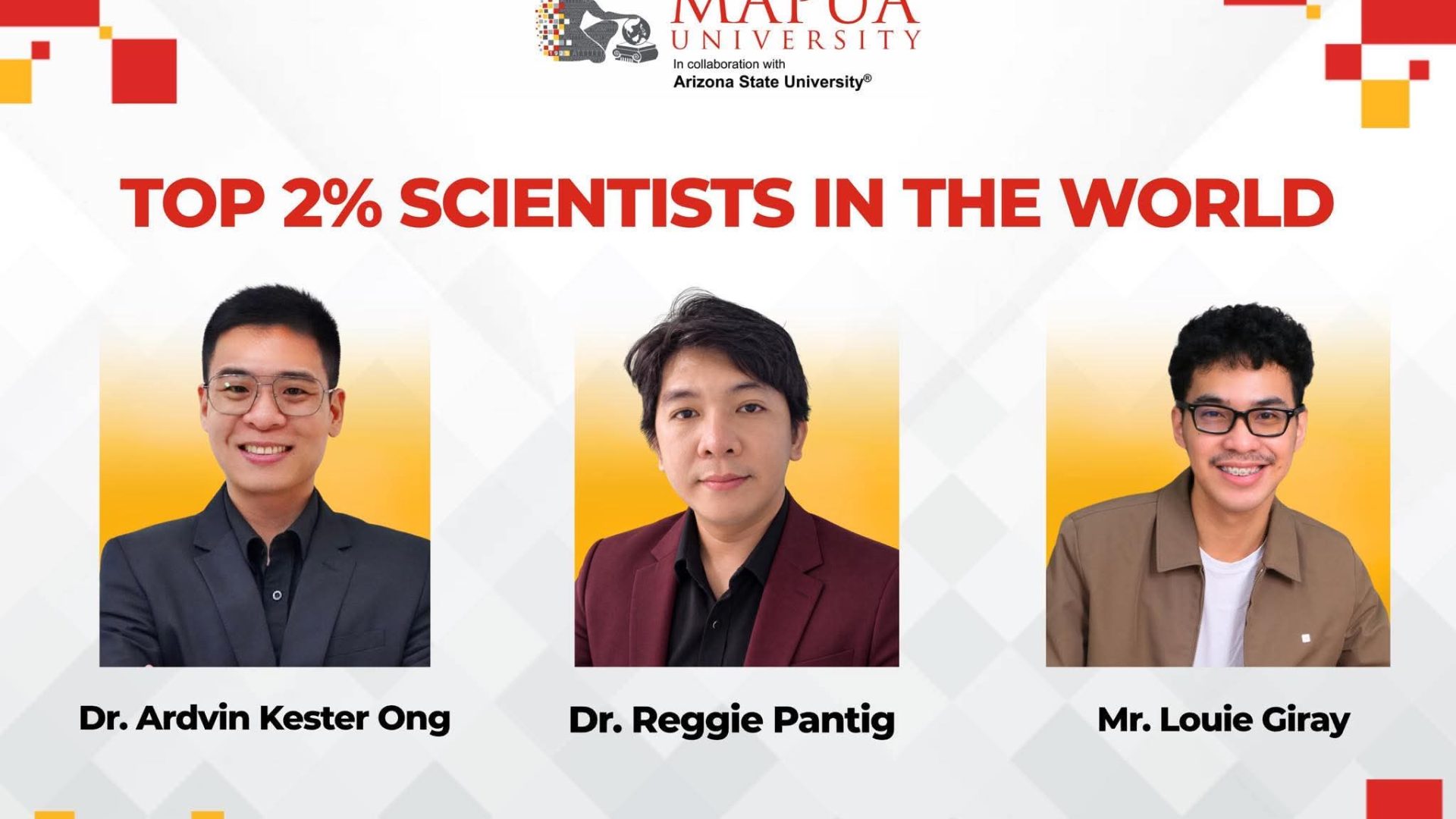
The researchers’ overall rankings were based on the composite citation score (c-score) across all scientific disciplines, which combines six bibliometric indicators: total citations, h-index, co-authorship-adjusted hm-index, and citations to publications where the researcher is the sole, first, or last author. In addition to their overall rankings, each researcher was also ranked within their respective fields and subfields of specialization.
Dr. Ong, Associate Dean for Institute for Digital Learning and Associate Professor for the School of Industrial Engineering and Engineering Management, ranked 23rd in the country and 90,669th globally across all scientific disciplines. Under his main field of Enabling and Strategic Technologies, specifically the subfield of Energy, he ranked 2,749th out of 371,956 researchers worldwide. Dr. Pantig, a professor specializing in theoretical physics, placed 13th in the Philippines, and 54,041st globally across all scientific disciplines. Under the main field of Physics and Astronomy, specifically the subfield of Nuclear and Particle Physics, he ranked 683rd out of 164,120 researchers worldwide. Meanwhile, Mr. Giray, Assistant Professor and Head of Research for the Department of Liberal Arts, ranked 6th in the Philippines, with a global rank of 24,177 across all scientific disciplines. Under the main field of Social Sciences, specifically in the subfield of Education, he ranked 352nd out of 115,687 researchers worldwide.
The Stanford Top 2% Scientists ranking is an internationally recognized distinction given to researchers whose work have demonstrated exceptional citation impact and influence in their specific fields. Not all researchers can qualify to join the rankings since their body of work must be heavily vetted, reviewed, cited and accepted by their peers. In other words, the global scientific community must test and approve a scientist’s work to qualify.
To be included in the rankings is a huge feat, and the fact that these three seasoned and highly-credentialed educators still hold active roles in Mapúa while dedicating themselves to research and development, is awe-inspiring. Despite having a full teaching load and administrative responsibilities, they continually make the effort to conduct scientific inquiries that could potentially improve the way we live or lay the foundation for future studies.
A commitment to discovery
Although the three professors specialize in different fields, what sets the three of them apart from others are their thirst for knowledge, inquisitive nature, acumen for discoveries and scientific investigations, and their ability to dissect and connect diverse complex concepts into a cohesive solution or theory. However, their passion for advanced research didn’t develop overnight. Their research journeys began with an interest in understanding concepts beyond what was already known, eventually leading them to pursue independent investigations and publish their findings.
For Dr. Pantig, his fascination with the cosmos led him to explore theoretical physics, astrophysics, and black hole phenomenology. His initial study inspired him to investigate further. Before he knew it, he had already published 87 scopus-indexed papers.
“I do not aspire to stand above other thinkers. I aspire to stand at the intersections of their ideas, where established knowledge may c*nverge into something new,” said Dr. Pantig, explaining his interest in bringing established concepts together to develop new insights.
Dr. Ong and Mr. Giray also discovered their calling for rigorous scientific research in graduate school. After publishing their first research papers, they continued pursuing research projects and producing scholarly work, including during the COVID-19 pandemic in 2020.
Their sustained commitment to research demonstrates that the pursuit of knowledge extends beyond a single publication or academic milestone. It requires continuous learning, a willingness to question established ideas, and the discipline to investigate problems from different perspectives.
Bringing research into the classroom
For the three professors, research is not separate from teaching.
Dr. Ong, whose research focuses on Enabling and Strategic Technologies, Energy, and Artificial Intelligence, explained that his work has helped him become a more effective mentor by allowing him to share updated and relevant insights with his students.
“The scientific inquiries that I do push me to discover new insights, which I then pass on to my students. It also gives me the opportunity to correct outdated textbook concepts and provide them with the appropriate foundational knowledge supported by new learning,” Dr. Ong said.
His experience writing journal articles has also helped him guide students in selecting research topics, refining their work, and approaching problems through scientific inquiry. Having authored more than 200 research papers over five to six years, he draws on his own research experience to help students strengthen their work and develop a deeper understanding of their chosen fields.
On the other hand, Dr. Pantig guides students in solving manageable research problems using math and theoretical concepts, preparing them to conduct their own research. Through this process, students learn to apply what they have studied, formulate questions, and develop their capacity for independent inquiry.
Meanwhile, Mr. Giray shares a similar perspective with Dr. Ong in terms of immersing himself in the subjects he teaches to his students. With research interests spanning in Social Sciences, Education, and Information and Library Sciences, he believes that educators who teach research should also remain actively engaged in it. He echoes financial educator Robert Kiyosaki’s concept of a “fake teacher”—an educator who teaches subjects without practical, real-world experience in the field.
“I teach students research, so I might as well do the same thing. I need to walk the talk so I can face my students with integrity and share with them best practices and topics that are trendy and not outdated anymore,” Mr. Giray said.
Sustaining a culture of research and innovation
Despite their accomplishments and experiences, the professors continue to face challenges in conducting research, including limited time, funding, equipment, and access to research networks. They credit Mapúa for supporting their research endeavors through funding, incentives, travel opportunities, and collaborative projects that help advance their work.
Their recognition reflects the contributions of faculty members who continue to pursue research while fulfilling their responsibilities as educators and academic leaders. It also underscores the importance of an environment where scholarly inquiry, collaboration, and the exchange of knowledge can thrive.
As Mapúa University continues to strengthen its research and innovation initiatives, the works of Dr. Giray, Dr. Pantig, and Mr. Giray demonstrate how research can extend beyond academic publications. Through their investigations, mentorship, and commitment to teaching, they help prepare students to ask better questions, examine complex problems, and contribute to future discoveries.
Learn more about Mapúa University’s academic programs, research works, and initiatives at www.mapua.edu.ph.